


Joana Deplazes, 22 December 2025
Purify the air
Air purifiers for medical practices – for hygienic indoor air
Air purifiers make an important contribution against viruses and bacteria. As the cold season returns, so does the cold season. Infectious patients meet in waiting rooms. Indoor air quality is very important here. It has a decisive influence on the transmission of viruses and bacteria as well as on well-being. Air purifiers make an important contribution to this. Especially in areas with a high number of visitors or in treatment rooms, they reduce the load of viruses and bacteria in the air.
Find out in this article
- Significant reduction of bacteria and viruses
- Effectiveness of air purifiers confirmed with studies
- What are the effects of poor air quality?
- How does an air purifier work? Advantages for medical practices
- What do I need to look for in an air purifier for a doctor's practice?
Significant reduction of bacteria and viruses
In a medical practice, there are often many people in one room. These groups of people are often more susceptible to viruses and bacteria. Aerosols can be propelled up to 60 meters by coughing and sneezing. Bacteria and viruses circulate throughout the doctor's practice and infect other patients and staff. This is why an air purifier is very useful. The device can be used in the waiting room and in the examination room.

Effectiveness of air purifiers confirmed with studies
The effectiveness of air purifiers is also confirmed with a study by the University of the Federal Armed Forces in Munich. A room measuring 80 square meters was equipped with an air purifier. Within a very short time, the concentration of aerosols war reduced to a low level.
This study also pointed out that the room air purifier is most effective when positioned in the centre of the largest side of the room. This ensures optimum distribution of clean air. Even in winter, when windows are opened less, the air purifier ensures that the viral load is kept to a minimum.
Aerosol expert Professor Dr Christian Kähler is also convinced of the effectiveness of professional air purifiers. In his opinion, they can significantly reduce the viral load in indoor air. He emphasises that air purifiers in doctors' practices are worthwhile because they reduce the risk of infection.
The Roger and Roger big air purifiers are ideal for these applications.
What are the effects of poor air quality?

Poor air quality can lead to asthma and trigger allergies. It can also increase the risk of lung cancer. Pollutants in the air are particularly problematic for people who already suffer from lung diseases. They are particularly sensitive to polluted air and often spend even more time indoors than other people.
Gases such as nitrogen dioxide and ozone as well as fine particles enter our airways when we breathe and then enter our lungs. Small particles penetrate deeper into the lungs. They are then deposited in the bronchi and alveoli. This can have short or long-term effects on health.
Noticeable problems from poor indoor air
- Dizziness
- Headaches
- Prolonged flu-like symptoms
- Feeling of lack of oxygen
- Shortness of breath
- Cardiovascular diseases
- Nausea
- Asthma that worsens
- Allergies
An air purifier can help to alleviate symptoms and ensure better air quality in the long term.
How does an air purifier work? Advantages for medical practices
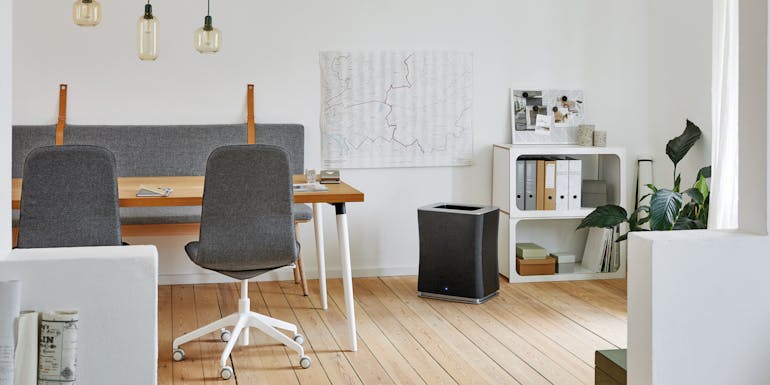
Air purifiers filter the air and reduce pollutants, odours and gases from the air. They also remove other particles from the room air. These include dust, pollen, animal hair, bacteria and viruses.
First, the air purifier draws in the air. This allows the pollutants to be removed. For this to work, there is a fan installed inside the appliance. The air drawn in is then passed through filters. If the appliance has a pre-filter, this already traps larger particles. These can be hair or dust, for example. A HEPA filter is then usually used for the main filtration of pollutants. HEPA stands for "High Efficiency Particulate Air Filter". Stadler Form offers two different kinds of HEPA filters.
- HEPA filter H12: a HEPA filter H12 can filter at least 99.5 per cent of particles between 0.1 and 0.3 micrometers from the air. One micrometer corresponds to 0.001 millimeters. A hair is about 60 times thicker than a micrometer.
- HEPA filter H14: the HEPA filter H14 is even denser, i.e. it filters out even more dirt particles. This means that it achieves a filter performance of at least 99.995 per cent.
Stadler Form offers a combination of HEPA and activated carbon filters. In addition to filtering pollutants with the HEPA filter, the activated carbon filter adsorbs gases. These include bad odours, tobacco smoke and volatile organic compounds (VOCs). The filter is called a Dual Filter at Stadler Form because it consists of two components. It must be replaced every eight to twelve months.
After the air has been drawn through the filters and filtered, the cleaned air is released back into the room through an opening.
What do I need to look for in an air purifier for a doctor's practice?
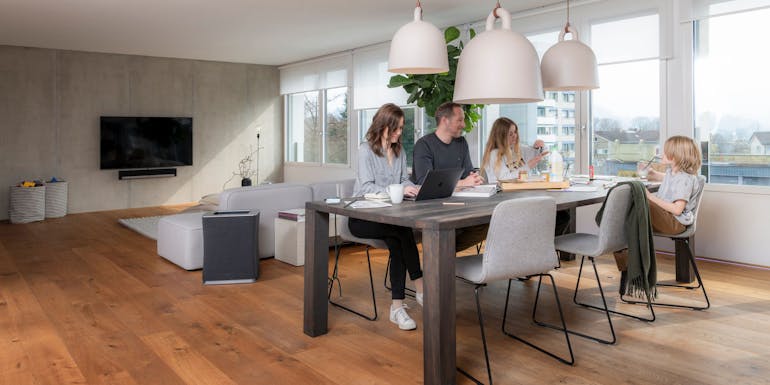
What do I need to look for in an air purifier for a doctor's practice? People are treated for health issues in a doctor's practice. Cleanliness is important for health. Many infections are transmitted with viruses in the air. It is essential to ensure good indoor air quality. Air purifiers are very important here, as they can reduce pathogens. You should consider the following when buying.
- Room size and air exchange rate: in addition to the effectiveness of the air purifier, the air exchange rate is also decisive. The air exchange rate indicates how often the entire volume of air in the room is exchanged within an hour. The performance of the appliance depends on how large the room is. You can find a room size recommendation for air purifiers on our website. This recommendation is based on the air exchange rate. Stadler Form specifies this as once per hour.
- Filter technology: make sure that the air purifier for the doctor's practice uses high-quality HEPA filters. Decide whether you want a combined HEPA filter including activated carbon filter. This will also filter unpleasant odours and gases out of the air.
- Consider the noise level: take the noise level of the appliance into account when purchasing. Depending on the place of use, you can avoid unnecessary noise emissions. Patients should not feel disturbed by the noise in the waiting room, for example. Staff should also benefit from the clean air but be able to carry out their work undisturbed.
Positioning: to ensure that the air can be optimally drawn in and distributed, it is best to position the device free of obstacles in the doctor's practice. Pay attention to the dimensions and design of the appliance in addition to its performance and room size, in case this is important to you.
To summarise, air purifiers make an important contribution to air quality. Pollutants are minimised and even the smallest particles are removed. A powerful HEPA filter removes fine dust, pollen, viruses, bacteria and pollen from the air. This ensures significantly improved hygiene indoors.
Our air purifier ensures a pleasant indoor climate. They also reduce unpleasant odours. The device helps to ensure that patients feel comfortable and supports the working conditions for staff. Air purifiers are therefore an efficient and simple addition to existing hygiene concepts.
Would you like to find out more about air purification? On our information page you will find useful tips and tricks as well as everything you need to know about indoor air purification.
If you have questions related to indoor room climate, please get in touch with us. Or subscribe to our newsletter to regularly get informed about current topics regarding indoor climate, experience reports or Stadler Form insights.


