


Lea Bieri, 21 May 2026
Regulating air temperature
Fan or air conditioner: what really helps on hot days?
On hot days, we long for a bit of relief from the heat. Every summer, we ask ourselves what really helps and how we can keep indoor spaces cool during the hot season. Every year, the question also arises as to whether a fan or an air conditioner is the better choice. In this article, you’ll find out what the differences are between an air conditioner and a fan.
Find out in this article
- Fan or air conditioner: what’s the difference?
- Fan or air conditioner: a comparison of indirect vs. direct cooling
- Which uses more electricity, an air conditioner or a fan?
- Flexibility and mobility of fans and air conditioners
- Environmental friendliness of fans and air conditioners
Fan or air conditioner: What is the difference?
The main difference lies in how the two devices work.
How does a fan work?
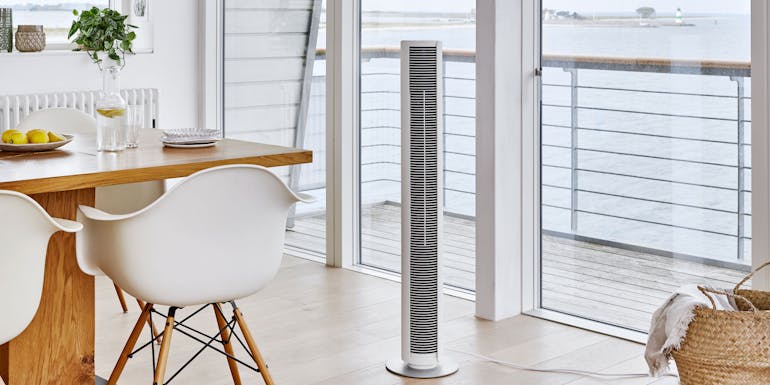
A fan usually consists of a motor that drives a rotor with blades. These blades circulate the air in the room and generate a breeze. This creates air circulation that blows away the warm layer of air above the skin, promotes evaporation on the skin and thus indirectly cools the body. The room temperature is not cooled. There are various types of fans, such as pedestal, tower, table, floor and 3D oscillating fans. Fans are flexible and can be easily moved, so they can be used wherever they are needed.

How does an air conditioner work?
Air conditionersair conditioners actively reduce the room temperature. Warm air from the room is drawn in; inside the unit, it flows over a heat exchanger where refrigerant absorbs the heat. The warm exhaust air produced during this process is channelled directly out of the unit via a hose. The cooled air is blown back into the room.
There are portable models where the exhaust air hose can be temporarily attached to a window, or fixed installations that must be professionally fitted. A distinction is made between monoblock and split systems. In monoblock air conditioning units, the entire refrigeration unit is housed in a single casing, whilst split air conditioning units consist of two parts. Both variants are available as fixed installations and portable solutions.
In the Stadler Form range, you will find not only fans but also a mobile monoblock air conditioner. As of summer 2026, however, this ist available exclusively in Switzerland.
We have summarised the key differences for you in this table.

Fan or air conditioner: a comparison of indirect vs. direct cooling
With passive, indirect cooling via a fan, the body’s heat dissipation is improved thanks to air circulation. The question of whether a fan provides cooling can be answered with a yes. When a fan’s airflow hits our skin, it carries away the warm air that has built up and promotes evaporation on the skin. The wind blows away the insulating layer around the skin. Heat can be released more effectively. Evaporation and sweat on the skin are removed more quickly. The result: a refreshing, cooling sensation.
An air conditioner extracts heat from the air in the room and expels it outside using energy. The air from which the heat has been extracted, is released back into the room. This physically lowers the room temperature – it is actively cooled. On particularly hot days, actively cooling the air in the room using an air conditioner is a quick and effective solution to the heat.
Which uses more electricity, an air conditioner or a fan?
At first glance, it seems clear that an air conditioner comes off worse in terms of electricity consumption and, consequently, cost-efficiency. Whilst this is essentially correct, on closer inspection the picture becomes somewhat more nuanced. And importantly (!), it always depends on the performance and consumption of the individual unit.
Generally speaking, a fan consumes significantly less electricity than an air conditioningair conditioning system and is therefore more cost-effective. However, on hot days, a fan usually runs for 24 hours to ensure the air in the room is constantly circulated, which can drive up costs.
Air conditioners can be used in a more targeted manner. For example, it can be run for one to two hours before going to bed to actively cool the room for the night. With the Emil air conditioner from Stadler Form, this can also be controlled remotely whilst you’re out and about. If the unit has a built-in thermostat, it switches off automatically once the desired room temperature is reached.
Electricity consumption and costs can also be reduced by ensuring that windows and doors remain closed whilst the unit is running. Find out here how to get the most out of your air conditioner.

Flexibility and mobility of fans and air conditioners
Fans offer a high degree of flexibility and mobility. They come in various sizes and types, which can be placed in the room, on sideboards or office desks as required, and their airflow direction is individually adjustable. The Stadler Form range includes the following types of fans
- Stand fans
- Tower fans
- Table fans
- 3D fans
- Floor fans
When it comes to air conditioning systems, a distinction is made between monoblock and split systems. A split air conditioning system consists of two parts, one of which is installed indoors and the other outdoors. Monoblock air conditioning systems consist of a single unit. The entire refrigeration unit is housed within a single casing.
Both types are available in portable versions and models that require fixed installation. Fixed installations are neither flexible nor portable, but offer other advantages; however, they are usually only suitable for owner-occupied properties. Consequently, the portable monoblock air conditioner is a popular and practical solution for private households. It is compact, has castors and requires only a temporary installation at the window for the exhaust air hose. This can usually be removed without leaving any residue at the end of the season, as is the case with the Emil model from Stadler Form, for example. This provides mobility and flexibility.

Environmental friendliness of fans and air conditioners
Environmental impact can be an important factor when deciding between an air conditioner and a fan. The different operating principles also have varying environmental impacts.
A fan is more energy-efficient by comparison, as it requires less electricity to circulate the air in the room. In contrast, an air conditioner actively cools the room temperature in a closed circuit. It achieves a stronger cooling effect, which requires a higher energy input. Regulations on refrigerants are constantly being tightened, and modern systems are increasingly relying on more climate-friendly substances.
In a nutshell: fans are suitable for low-energy everyday use, whilst air conditioning is best for combating high heat, although it is the more energy-intensive solution.
Ultimately, you’ll need to decide for yourself, based on your individual situation, whether a fan or an air conditionerair conditioner is the right choice.

Want to find out more about how you can protect yourself from the heat in summer and keep your home cool? You can find more information on our information page about cooling your flat.
If you have questions related to indoor room climate, please get in touch with us. Or subscribe to our newsletter to regularly get informed about current topics regarding indoor climate, experience reports or Stadler Form insights.


