Joana Deplazes, 30 mars 2026
Protection contre les virus
Cleaning and descaling humidifiers – tips for keeping your humidifier germ-free
Do you own a humidifier? Then this article is for you. You will learn why regular cleaning is important and what you should look out for. This is crucial for hygienic humidification and a longer service life for your appliance. As the season draws to a close, we have a step-by-step guide on how to store your humidifier. This way, your humidifier can reliably accompany you again after the season break.
Find out in this article
- Under what conditions do bacteria form in the humidifier?
- Hygienic humidifiers instead of bacteria – what do I need to consider when cleaning?
- How do I descale my humidifier?
- How often should I clean my humidifier?
- What happens if I don’t clean the humidifier?
- Distilled water for humidifiers
- What do I need to consider when cleaning at the end of the season and how do I store the humidifier correctly?
- What is the best way to clean the humidifier? We show you the ideal accessories
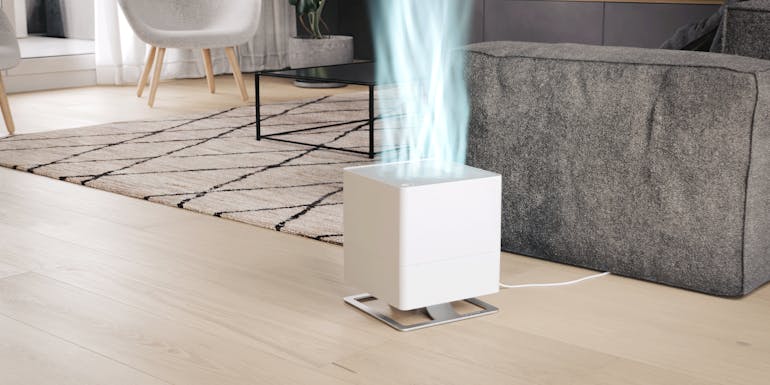
Under what conditions do bacteria form in the humidifier?
Humidifiers do not spread bacteria or germs in general. However, bacteria and germs can develop inside with neglected care. It is therefore important to clean the humidifier properly.
Dirt in and on the appliance can have various causes.
- The water used (e.g. not drinking water quality or water with a high limescale content)
- From the room air (house dust, animal hair, pollen and mites)
- If (contaminated) water is left in the unused humidifier for a long time; this can be a breeding ground for bacterial and microbial growth
Hygienic humidifiers instead of bacteria – what do I need to consider when cleaning?
To keep your humidifier hygienic, we recommend following the step-by-step instructions below.
- Fill with fresh, cold water of drinking quality every day.
- Clean and descale your appliance regularly. The Cleaner & Descalerfrom Stadler Form has been specially developed for the hygienic cleaning and thorough descaling of humidifiers.
- Use Hygiene Tabs or a Water Cube for ideal water hygiene in your humidifier.
- Also ensure the regular replacement of accessories such as filters in your device to inhibit the growth of bacteria and germs and to keep efficiency high.
- If the appliance is not used daily, it is important to empty, clean, descale and dry it thoroughly before switching it off. This way you will have a clean appliance the next time you use it.
Watch our video to learn how to clean a humidifier quickly and easily.
How do I descale my humidifier?
Take a regular look inside your humidifier. If you see limescale in the form of white deposits, it needs to be cleaned and descaled.
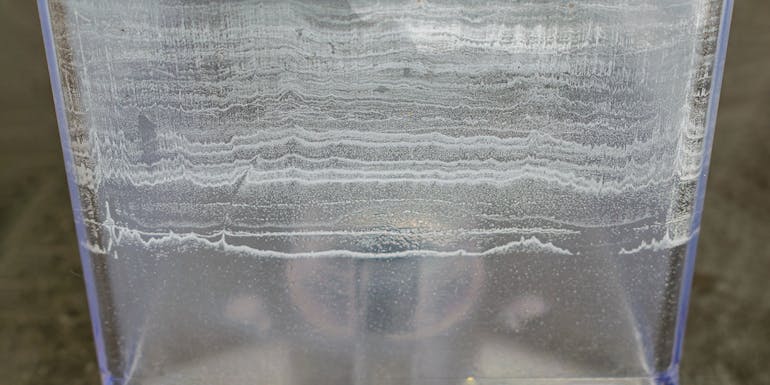
We recommend the Stadler Form Cleaner & Descaler for descaling your humidifier. Follow our step-by-step instructions.
- Pour some Cleaner & Descaler into the water tray. Ensure a mixing ratio of 50 to 50 per cent.
- You can then spread the cleaning mixture evenly with a brush. Does the solution no longer foam, and do you still see limescale? Then add a little more Cleaner & Descaler to the water tray.
- Leave everything to work for a maximum of 30 minutes (or according to the cleaning mode).
- You can then rinse everything out thoroughly.
In addition to the Cleaner & Descaler from Stadler Form, there are also household remedies that help to remove limescale in your humidifier.
- Citric acid: the citric acid must be mixed with hot water. You can then add the mixture to the water tray. Use a brush to loosen the heavy build-up. The water tray must then be rinsed out thoroughly.
- Vinegar (ideally cleaning vinegar or vinegar essence): add about 50 per cent vinegar and 50 per cent water to the humidifier’s water tray. Heavy build-up can also be removed with a brush. Then wash the water tray thoroughly.

How often should I clean my humidifier?
Regular, thorough and correct cleaning and descaling of every humidifier is very important. The time required for cleaning is small in relation to the effect on germ-free room air. The humidifier should be cleaned once a week. The size of the room does not matter. Regardless of the manufacturer and humidification system – whether hot steam or cold mist. Every appliance needs some attention if it is to remain germ-free. Descaling should be adapted to the water hardness and should also be carried out.
You will find information on how often and how intensively you should clean your appliance in our operating instructions.
What happens if I don’t clean the humidifier?
Water can form limescale deposits on any type of surface. Have you ever overlooked a water stain when cleaning the bathroom or kitchen? Then you have probably found a spot in the form of a white limescale stain when it dried. If this happens, your water contains limescale.
These white deposits are an ideal breeding ground for the growth of microorganisms such as bacteria or fungi. Bacteria and algae can multiply quickly, especially in stagnant water. Leave a used drinking glass for a week and see how the water in it develops. You wouldn’t want to drink the water at the end of the week, would you?
It’s the same with your humidifier. The appliance is happy to have fresh water and so are you, because the appliance then runs hygienically. As long as the humidifier is used and filled with fresh water, microorganisms can hardly settle. However, if the humidifier is not in use and is left filled with water, this can lead to microbial growth. If you were to switch the appliance on again, these contaminants from the water would spread into the room air. We don’t want that.
Distilled water for humidifiers
To avoid contamination with water of insufficient quality and limescale build-up with hard water, it is possible to use distilled water. Distilled water is produced with vaporisation of the water. This removes organic substances, salts, microorganisms and other foreign substances. But beware, not all humidification systems can be operated with distilled water. It cannot be used in our vaporisers. If you are using a device from another brand, contact the manufacturer for more information.
As the use of distilled water is associated with high costs in most countries, we recommend using a 50:50 mixture with tap water. This video explains in detail how to use this mixture. The mixture of tap water and distilled water contains less limescale, which leads to a reduction in limescale deposits.
Important note: please note that the use of distilled water is no substitute for regular cleaning of the humidifier.
Do you
have a descaling system in operation?
If you use
water from a descaling system, you should ask the manufacturer about a suitable
device before purchasing a humidifier. You can find out whether a water
decalcification system is installed by contacting the property management.
Water from the descaling system contains significantly less limescale,
depending on the amount of salt used. The salt content changes the composition
of the water, which reduces the formation of limescale. The more salt is used,
the lower the hardness of the water and the less limescale the water contains.
However, the large amount of salt in the water also leads to deposits in the humidifier.
In this case, it is salt deposits instead of limescale. These are also an ideal
breeding ground for microorganisms. Therefore, check the inside of your humidifier
regularly and clean and descale the appliance regularly.

What do I need to consider when cleaning at the end of the season and how do I store the humidifier correctly?
The humidifier also needs your attention again at the end of the season so that it can take a well-earned break. In the new season, you will be pleased that you have stowed the humidifier away cleanly.
Clean and dry components: make sure that all parts are clean and dry before packing your humidifier and putting it away.
The following step-by-step guide will help you to store your humidifier correctly at the end of the season.
- When is the right time? this depends on the weather and the humidity in your home. As winter slowly recedes and the days get warmer again, indoor humidity levels usually rise. If there are no more cold days in sight, you can switch off the humidifier, pour out the remaining water and observe with a hygrometer for a few days to make sure the humidity doesn’t drop too low before storing the appliance away completely. If the relative indoor humidity is constantly above 45 per cent around spring, most people no longer need humidifiers.
- Clean and descale your humidifier: refer to your humidifier’s operating instructions for precise instructions. Make absolutely sure that all components are completely dry before packing.
- Replace the humidifier accessories: at the end of the season, you should also replace the accessories depending on the system, such as filters, Hygiene Tabs / Water Cube and anti-calc cartridge. You should not store a used anti-calc cartridge for a long time, as the resin inside is saturated with water, which creates a breeding ground for the growth of microbes and mould.
- Leave the new accessories in their original packaging and pack them together with your humidifier. This will save you the hassle of having to collect them when you put the humidifier back into operation.
- Pack your humidifier: it is best to pack your humidifier in its original packaging or in a protective cover. We offer a protective cover for certain humidifiers. It is also important that you store the humidifier in a dry place.
Additional tip (currently only available in Switzerland for Stadler Form products): would you like to leave the thorough cleaning and descaling to someone else at the end of the season? Then take advantage of our all-round carefree service for your roommate for some appliances. Our team will clean your humidifier and check all functions. You will also receive new filters, a new Water Cube or Hygiene Tabs, a bottle of Cleaner & Descaler and a 1-year guarantee on the service carried out.

What is the best way to clean the humidifier? We show you the ideal accessories
To achieve a better hygiene experience and reduce limescale deposits, the accessories recommended by the manufacturer should be used. Most manufacturers provide a recommendation for the respective period of use of the accessories. The guidelines for replacing accessories should be followed to keep your appliance hygienic and working efficiently. Different accessories are required depending on the humidification technology.
You can find more information on the various humidifier systems on our information page on humidifying the air. Find out more here.
Evaporators work with one or more filters to evaporate the water. We recommend replacing the filters every two months to support hygiene in the appliance. These accessories should be replaced during the operating time, but also before the appliance is put away or put into operation after a long period of inactivity. We generally recommend the use of the Water Cube or Hygiene Tabs for Stadler Form humidifiers and an additional anti-calc cartridge for ultrasonic humidifiers and air washers (for the latter with a water hardness of over 21 °dH).
Would you like to find out more about how a humidifier can help you feel better or what different humidifier systems are available? You can find more information on our information page about humidifying the air.
More about humidifying the air
If you have questions related to indoor room climate, please get in touch with us. Or subscribe to our newsletter to regularly get informed about current topics regarding indoor climate, experience reports or Stadler Form insights.